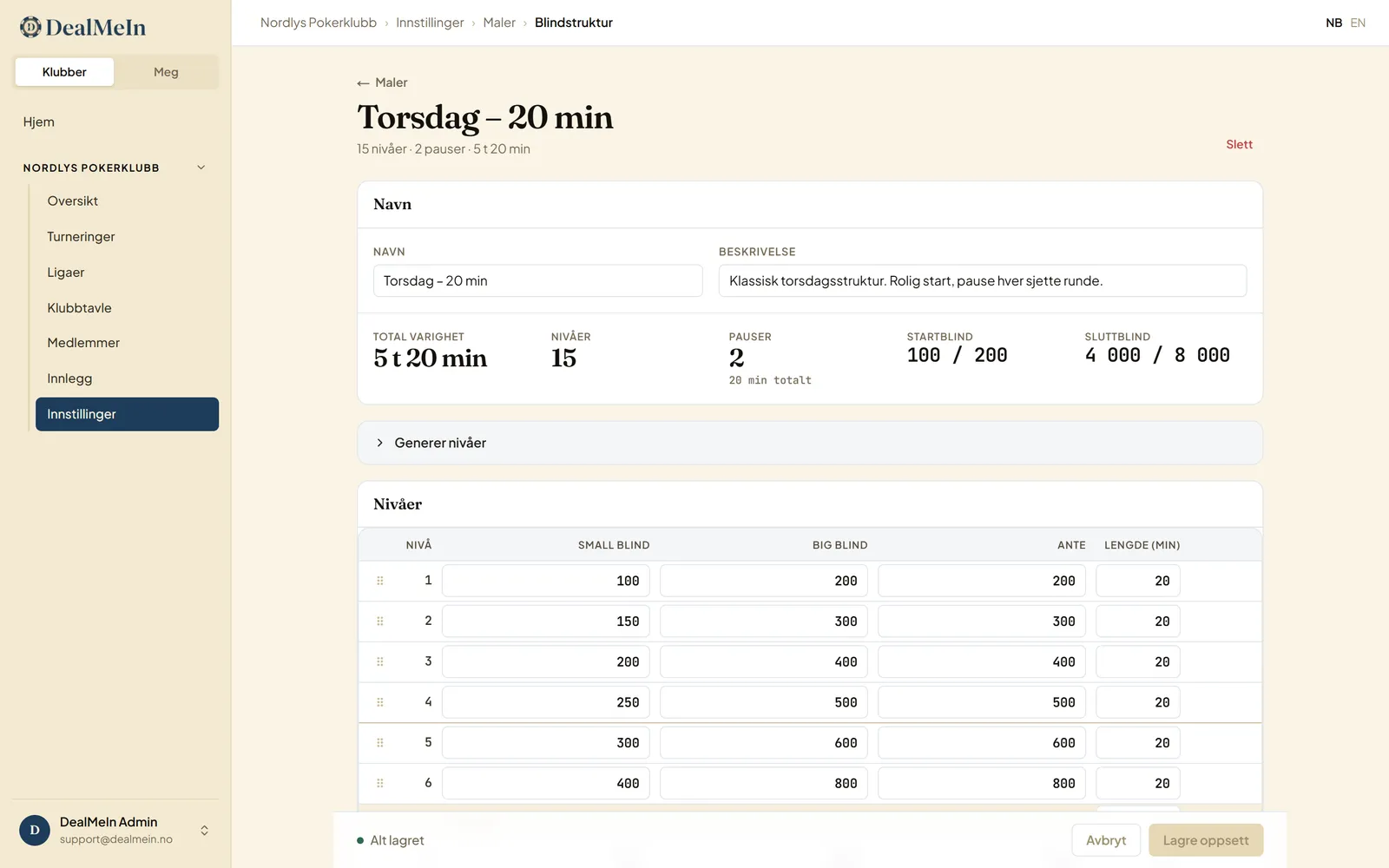
The blind structure decides how long the tournament lasts and how much actual poker gets played along the way. The wrong structure gives you either a night that never ends or one that turns into a lottery after an hour. The right structure is not hard — it is three numbers that have to fit together.
The three numbers
Starting stack in big blinds. 10,000 in chips says nothing on its own; 10,000 at blinds 25/50 is 200 big blinds and plenty of play, 10,000 at 100/200 is 50 and not much. For home games, 75 to 150 big blinds at the start is a good place to be. Deeper takes a long time to play down; shallower means all-ins early.
Level length. How many minutes each blind level lasts. 15 minutes for a short night, 20 for a normal one, 25 to 30 if you have the whole evening. Keep every level the same length — it is easier to follow.
The increase. How much the blinds rise per level. Around 30 to 50 percent per level is typical. Less makes it slow; more makes it abrupt. Big jumps early are worse than big jumps late.
How long it lasts
A rule of thumb: the tournament ends when the big blind is about one twentieth of all chips in play. Nine players with 20,000 each is 180,000 chips, and heads-up is in practice decided when the big blind reaches 8,000 to 12,000.
Count the levels up to that point, multiply by the level length, add breaks, and you have the duration. Rebuys and add-ons add chips and stretch the night by one or two levels.
Three ready-made structures
All three are built for six to nine players. With two tables, add two levels at the end.
Short night — about 2.5 hours
Starting stack 10,000. 15-minute levels. Break after level 5.
| Level | Small blind | Big blind | Ante |
|---|---|---|---|
| 1 | 25 | 50 | – |
| 2 | 50 | 100 | – |
| 3 | 75 | 150 | – |
| 4 | 100 | 200 | – |
| 5 | 150 | 300 | – |
| 6 | 200 | 400 | 400 |
| 7 | 300 | 600 | 600 |
| 8 | 400 | 800 | 800 |
| 9 | 600 | 1,200 | 1,200 |
| 10 | 800 | 1,600 | 1,600 |
| 11 | 1,000 | 2,000 | 2,000 |
| 12 | 1,500 | 3,000 | 3,000 |
Standard — about 3.5 hours
Starting stack 20,000. 20-minute levels. Break after level 5. Rebuys through level 5.
| Level | Small blind | Big blind | Ante |
|---|---|---|---|
| 1 | 100 | 200 | – |
| 2 | 150 | 300 | – |
| 3 | 200 | 400 | – |
| 4 | 300 | 600 | – |
| 5 | 400 | 800 | 800 |
| 6 | 500 | 1,000 | 1,000 |
| 7 | 700 | 1,400 | 1,400 |
| 8 | 1,000 | 2,000 | 2,000 |
| 9 | 1,500 | 3,000 | 3,000 |
| 10 | 2,000 | 4,000 | 4,000 |
| 11 | 3,000 | 6,000 | 6,000 |
| 12 | 4,000 | 8,000 | 8,000 |
| 13 | 6,000 | 12,000 | 12,000 |
Turbo — about 1.5 hours
The same levels as “Short night”, but 10 minutes per level and no ante. Right for fitting two tournaments into one evening.
About antes
An ante is a small forced bet from everyone before each hand, and it exists to give people a reason to play when the blinds are otherwise small compared to the stacks. At home, the big blind ante is the simplest: one player — the one in the big blind — posts the ante for everyone, equal to the big blind. No small chips from nine players every hand, and nobody forgetting.
Start antes from around the halfway point. Before that they are not needed.
Breaks and rebuys
Put the break where the rebuy window closes. The first half is relaxed, and everyone knows it gets serious after the break. If you allow an add-on, do it during the break so play never stops.
Common mistakes
- Too shallow a start. 30 big blinds at the start is not a tournament, it is a lottery.
- Levels that jump. From 200/400 to 500/1,000 is more than a doubling. Put 300/600 in between.
- No planned ending. The structure needs enough levels to reach a result. If the clock runs out of levels, you are improvising with three players left at one in the morning.
- A clock nobody owns. One person runs the clock, or it runs itself. Levels that “run a little over” are how a three-hour tournament becomes five.
In DealMeIn
The blind structure is a template you build once per club. The clock in the tournament room changes level on its own, shows the next blinds and the break, and can go on a TV in the room. See Templates and setups in the help centre.