One poker night is pleasant. A season with a ranking is something people clear their calendar for. The difference is a points system — and a few rules decided before round one.
What the points should reward
Before you pick numbers, decide what counts:
- Placement. Obviously. First place should give clearly the most, but not so much that one win decides the season.
- Field size. Winning against twelve is more than winning against six. Points should scale with how many played.
- Few bullets. Whoever won after three rebuys used four attempts. Whether that costs points is a choice — but a common and sensible one.
- Attendance. Should there be points just for showing up? A little can make more people come. A lot means the ranking measures attendance, not poker.
Two ways to count
A fixed table is easiest to understand: 10 points for a win, 7 for second, 5, 3, 2, 1 and so on. Everyone can do it in their head. The downside is that it knows nothing about the field — a win against five scores the same as against fifteen.
A formula takes field and bullets into account. DealMeIn uses this one, and it is a reasonable starting point whatever tools you use:
points = √( entries × base points / your bullets ) ÷ (place + 1.2)Entries is the whole field measured in buy-ins (players plus rebuys and add-ons), base points is a constant — 5,000 works — and your bullets is your own buy-in plus your own rebuys. Nine players with three rebuys is 12 entries; a win on one bullet then scores 111, second place 77, and fifth after one rebuy 28. Worked examples are in How points are calculated.
Whichever method: write it down and share it before the season. A points system that changes mid-season is an argument waiting to happen.
Count the best nights, not all of them
The single most important rule for keeping people interested: only the best N nights count. With twelve rounds in the season and eight counting, someone can miss four nights without being out of it. Otherwise the player who was on holiday in August drops off, and stops coming in October.
For the same reason, have a tie-break ready: most wins, then most counting nights, then best average.
Total or average
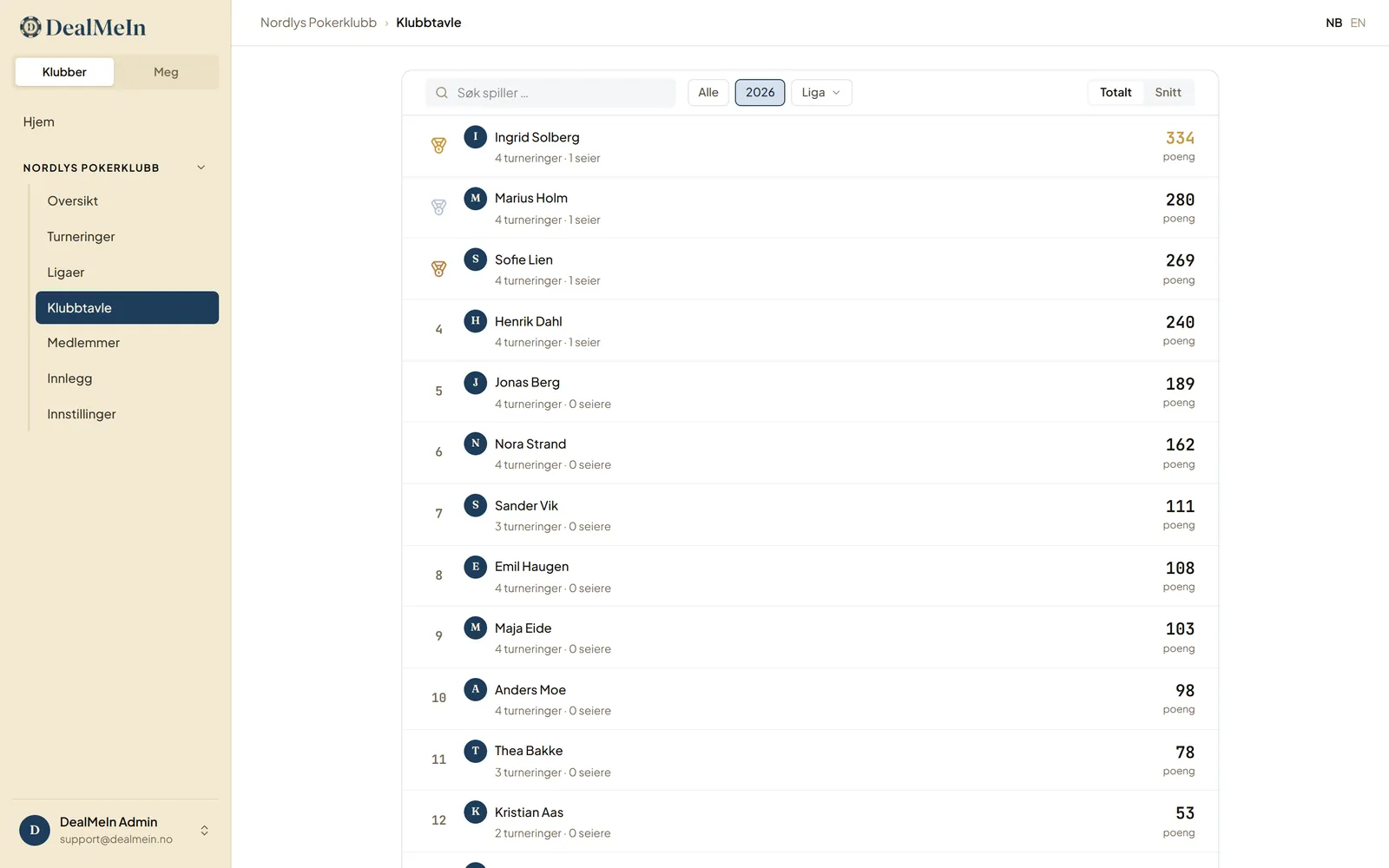
Show both. Total rewards turning up often. Average per night makes it fair to compare someone who played five nights with someone who played twenty. They answer different questions, and it is rarely the same person on top.
Leagues: two kinds
A league is a season with a set number of rounds, fixed rules and an end. Two kinds are common:
Points league. The ranking is the prize. Whoever is top when the last round is played has won the season. Simple, and entirely without stakes if you want.
League with a season pot. A small share from each night is set aside for the end of the season, and split by the final standings — or played for in a final. This is an agreement between the players, like everything else at the table. Write it down: how big a share, how many places, and how it is split.
The final
The best ending to a season is a final table where season points become starting stacks. The leader starts with the most chips, but everyone is at the table, and anything can happen. No rebuys, no add-ons — one tournament that decides it.
It also gives those far down the table something to play for in the last rounds: every point is chips in the final.
Practical
- Fixed structure. The same blind structure and buy-in throughout the league. That is what makes the results comparable.
- Publish the standings after every night. Same place every time. The ranking is half the motivation, and it only works if people see it.
- Rules before round one. Points system, counting nights, tie-break, deals, final. Write it down and share it.
- Do not change mid-season. If you found a weakness in the system in November, note it for next season.
In DealMeIn
Leagues in DealMeIn come in both kinds, lock the structure once the league is announced, score with the formula above, count the best N rounds, and can end with a final table where stacks are set from season points. The club scoreboard shows total and average, per season and per league. See Leagues.